Comprehensive Air Quality Management Plan for Barranquilla
Financed by: Barranquilla Verde (District Environmental Authority).
Location: Barranquilla, Colombia.
Year: 2019 - 2020.
Project description
The project generated and integrated the technical and scientific tools needed for the comprehensive management of air quality in the District of Barranquilla, culminating in the formulation of the city's Comprehensive Air Quality Management Plan (PIGECA).
The Clean Air Institute led the technical process, which included:
-
Diagnosing air quality in Barranquilla and identifying its main determining factors.
-
Analyzing the city's emissions inventory.
-
Estimating health effects and associated costs of air pollution.
-
Applying the Integrated Environmental Strategies (IES) approach to prioritize policies, estimating local and global co-benefits.
The process was carried out through participatory consensus-building with local stakeholders, strengthening institutional capacity for informed decision-making.
Key findings
Air quality diagnosis
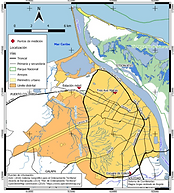
Barranquilla's warm, humid climate and steady northeasterly winds favor good pollutant dispersion for most of the year. Gas pollutant levels (CO, SO₂, NO₂) remain below regulatory limits, but PM10 and PM2.5 frequently exceed air quality standards — the pollutants of greatest concern for the city. Occasional wildfire episodes on Isla de Salamanca raise particulate levels temporarily, but do not explain the sustained high concentrations observed throughout the year; the data suggest natural sources also play a significant role, particularly for coarser particles. The city's southern district (near the Escuela de Policía monitoring station) consistently shows higher pollutant concentrations, pointing to greater exposure for residents in that area.
Monitoring network
Air quality is tracked through two fixed stations and one mobile unit, donated by the Government of the Republic of Korea through KOICA. The assessment identified opportunities to strengthen the network, including improving detection of low-range CO and SO₂ concentrations, reviewing data protocols, and adding a station closer to the urban core to better represent population exposure.
Emissions inventory (2018 baseline)
Based on data from 22 representative companies, fixed industrial sources emitted an estimated 249 tons/year of particulate matter (mostly from non-combustion processes), 2,134 tons/year of NOx (97% from combustion), 165 tons/year of SO₂, and 1,595 tons/year of VOCs (99% from non-combustion processes), with natural gas as the dominant industrial fuel. Maritime vessels and road transport (vehicles, buses, motorcycles) were identified as priority mobile-source contributors to NOx, PM10, and PM2.5.
Health impacts
Using the BenMAP model, the assessment attributed 26 deaths among adults over 18 in 2019 to air pollution exposure in Barranquilla, with an estimated economic value of USD 10.2 million based on Colombia's Value of a Statistical Life.
The Plan: goals and structure
The Plan sets a general goal of gradually improving Barranquilla's air quality through intersectoral action to protect public health and ecosystems, with a 2030 target aligned with WHO's interim guideline values for PM10 and PM2.5. It is organized into 5 structural lines — public and environmental health; air quality and emissions monitoring; low-emission competitive industry; sustainable mobility; and response to pollution episodes — supported by 3 cross-cutting lines: intersectoral coordination, culture and education, and monitoring and control. Together, these translate into 25 specific measures, each with defined targets, responsible entities, and tracking indicators.